Sep 14, 2026Packaging Machines Guides
Is a Desktop Cellophane Wrapping Machine Right for Your Boxes?
Wrapping tea, cosmetics or gift boxes by hand? See when a desktop cellophane wrapping machine fits, what to check before ordering, and how to test it.
What a desktop film wrapping machine actually does
If you sell tea gift boxes, cosmetics sets, or any product that looks better in a clear film wrap, you have probably wondered whether a desktop cellophane wrapping machine is worth it. This article helps a first-time buyer decide whether a small desktop film machine fits your boxes and your daily volume, and what to check before ordering one from anywhere.
This is for you if you wrap flat or rectangular boxes — tea tins and gift boxes, cosmetics cartons, phone-style retail boxes — you currently wrap by hand with tape or shrink bags, and neatness matters to your customers. It is probably not for you if you need to wrap bottles, pouches, or irregular shapes (different machines), if you run a full production line needing hundreds of wraps per hour (that is an automatic overwrapping line), or if your boxes are larger than the machine's film width. Numbers below are questions to ask any supplier, not answers — always confirm against your own boxes.
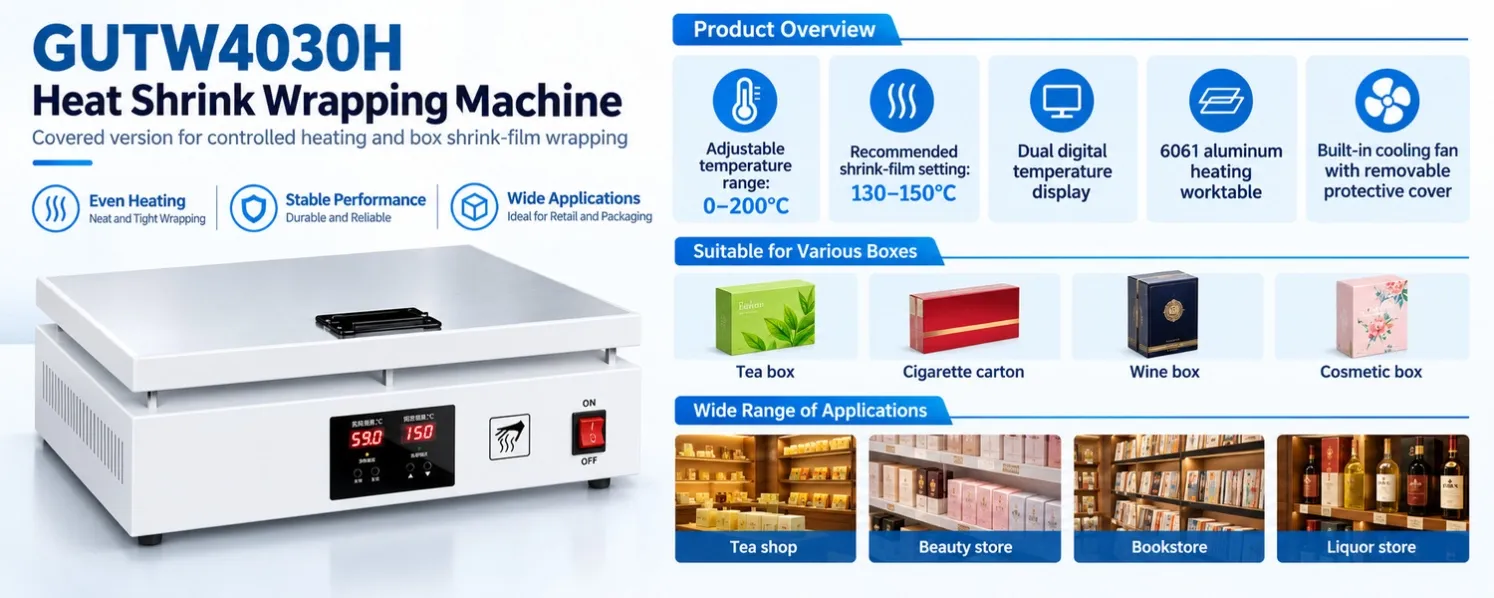
A desktop cellophane machine seals clear film around a product box using a heated element: you position the box in film, the machine seals and tightens the wrap, and the finished box looks retail-ready — the same look you see on cosmetics counters and tea gift sets. A compact model of the type we supply runs at around 20/min, weighs under 6.5 kg, and sits on a table, so one person can wrap boxes while doing other work.
The value is not just speed. Hand-wrapped boxes show tape marks, loose corners, and uneven film. A machine gives every box the same tight, clean wrap — and for gift products, that wrap is part of what customers are paying for.
The real cost of wrapping by hand
- You are the owner and often the packer, so every hour spent fighting film and tape is an hour not spent on products, photos, or customers.
- Hand-wrapped boxes come out uneven, and there is no simple way to make box number 200 look as good as box number 1.
- Machine listings show widths and prices, but not whether the machine handles your box size, your film, and your daily quantity — the exact evidence you need.
- So you either keep hand-wrapping while the workload grows, or you risk buying a machine that cannot take your largest gift box.
- The cost stays bounded but real: hours of slow wrapping each week, and a risk of a machine sitting unused because it was never matched to your boxes.
- The decision you can complete here: measure your boxes and your daily quantity, check four things below, and you will know whether to order one — or stop.
Four checks before you commit to any machine
1. Your box, measured
Write down your largest and smallest box: length, width, height. Desktop machines have a maximum film width and a practical box size range — the compact models we supply different commercial version for bigger boxes. If your largest gift box does not fit the film width, no other feature matters.
2. Your film
These machines use clear heat-seal film on a roll. Confirm with the supplier which film type, thickness and width the machine accepts, and whether film is included. Keep one spare roll on hand — running out of film mid-order is the small-business version of a power cut.
3. Your voltage — the check most buyers forget
Most compact models from Chinese factories run on 220–240 V mains. That fits Southeast Asia, the Middle East, and most of South America directly. If your country runs on 110–120 V (United States, Japan, and others), you need a step-up transformer or a 110 V version — ask the supplier honestly whether one exists before ordering. A machine that cannot plug into your wall is not a machine.
4. The supplier's proof, not their promises
Before paying, ask any supplier — including us — for:
- a real video of the machine wrapping a box similar to yours in size;
- a written spec sheet stating power, max film width, temperature range and weight;
- what happens if the machine arrives with a problem: who pays for parts, and how do you diagnose it remotely.
A supplier who wraps your type of box on video before you pay has answered most of your risk questions. One who only sends catalog pages has not.
Two mistakes we see first-time buyers make
Buying the biggest machine "just in case". If most of your boxes are one or two sizes, a compact model matched to them wraps better and costs less to ship. The wider commercial models make sense when your boxes genuinely need the extra width.
Forgetting the wrap is part of the product. Some buyers optimize only for speed and accept loose, wrinkled film. A slightly slower machine that gives every box a tight, clean wrap is worth more for gift products than a faster one that looks mediocre.
If it fits: what ordering from us looks like
We are a trading company based in Taizhou, China, supplying small packaging machines — including this type of desktop film wrapping machine — from vetted factories. In plain terms, we compare factories for your order, and we video-test every machine before it ships, so you see your actual machine wrapping a box before you pay the balance. Single-machine trial orders are welcome, and we confirm voltage compatibility for your country before quoting.
The next step is small: send a photo of your boxes with your daily quantity, and we will tell you honestly whether this machine fits — and if it does not, we will say so and tell you what would.