Sep 6, 2026Packaging Machines Guides
Paper Banding Machine for Small Products: When It Beats Hand Taping
Bundling small products with rubber bands or tape? See when a paper banding machine fits your products, what to check before ordering, and how to test it.
What a paper banding machine actually does
If you bundle small products — tea cakes, soap bars, notebooks, cosmetics sets, envelopes, or stacks of anything that needs to stay together — a paper banding machine may be the smallest machine that makes the biggest visible difference. This article helps a first-time buyer decide whether an automatic paper banding machine fits your products and daily volume, and what to check before ordering one.
This is for you if you band flat or rectangular items, you currently use rubber bands, tape, or hand-tying, and you want every bundle to look the same. It is probably not for you if you need to strap heavy pallets or big cartons (that is PP-strapping territory), if your items are soft, irregular, or smaller than the machine's minimum bundle size, or if you band fewer than a handful of items a day. Every model differs, so treat the numbers below as questions to ask, not answers — always confirm against your own products.
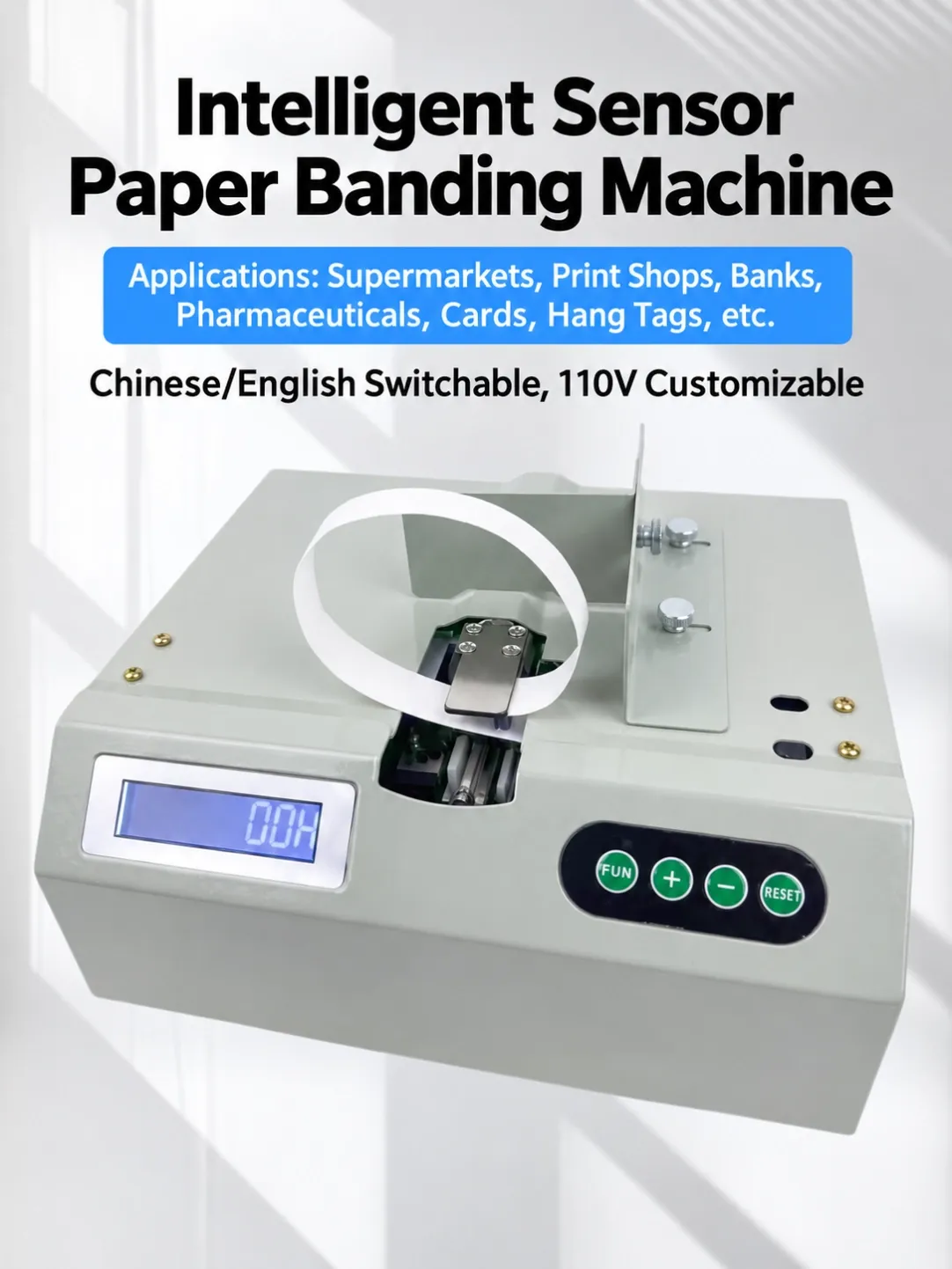
A paper banding machine wraps a narrow paper tape around a stack of items and seals the ends with heat, producing a flat, tidy joint — one press of a button per bundle. The type we supply is fully automatic in cycle: you position the bundle, the machine feeds the tape, wraps, welds and cuts, and the bundle comes out looking like it came from a factory line. Buyers use it for tea bricks and tea cakes, banknote and voucher bundles, playing-card decks, cosmetics gift sets, books, and small cartons.
Two things make paper tape different from plastic strapping: it holds firmly without crushing light products, and it reads as eco-friendly on the shelf — customers can tear it open and recycle it with the box. For brands selling natural or handmade products, that small detail matches the rest of the packaging.
The real cost of banding by hand
- You are the owner and often the packer, so every bundle means stretching a band or cutting tape by hand — dozens of times a day, with your fingers doing the consistency control.
- Hand-taped bundles come out loose or crooked, and tape damages the surface of the very products you are trying to protect.
- Machine listings show photos and prices, but not the bundle size range, tape width, or how the joint looks on your actual product — the evidence you need is missing.
- So you keep re-banding loose bundles, or you hesitate between models while the daily stack keeps growing.
- The consequence stays bounded but real: minutes lost per order and a risk that bundles arrive looking uneven — the opposite of what premium packaging should say.
- The decision you can complete here: measure your bundles, check four things below, and you will know whether to order one — or stop and keep it simple.
Four checks before you commit to any machine
1. Your bundle, measured
Write down your smallest and largest bundle: width, depth and height. Desktop banding machines have both a minimum and a maximum bundle size, and a tape width to match — the model we supply is adjustable, but [TO CONFIRM: min/max bundle size] must be confirmed with the supplier against your real products. Bring the extremes, not the average: the machine has to handle both.
2. Your tape
Paper tape comes in different widths and colors — plain white, kraft brown, or printed. Confirm the tape width the machine takes, whether tension is adjustable for light products, and how many rolls come with the machine (our supplier includes one; we recommend keeping three in stock). Ask whether printed tape with your logo is possible later — it turns the band into free branding.
3. Your volume and your voltage
Ask for the stated bundles-per-minute rate and honestly compare it with your daily quantity — this machine's value is consistency at modest speed, not line-speed output. Then check the mains voltage: most Chinese units run on 220–240 V, which fits Southeast Asia, the Middle East and most of South America; a 110 V custom version exists for markets like Taiwan, Japan-style sockets and the US — confirm availability for your country before ordering. A machine that cannot plug into your wall is not a machine.
4. The supplier's proof, not their promises
Before paying, ask any supplier — including us — for:
- a real video of the machine banding a stack like yours, showing the joint;
- a written spec sheet: tape width, bundle size range, speed, power and weight;
- what happens if the machine arrives with a problem: who pays for parts, and how do you diagnose it remotely.
A supplier who bands your type of product on video before you pay has answered most of your risk questions. One who only sends catalog pages has not.
Two mistakes we see first-time buyers make
Judging only by speed. Banding machines are not line equipment; their value is that bundle number 200 looks identical to bundle number 1. Match the machine to your products first, speed second.
Forgetting the tape is part of your brand. The band is the first thing the customer touches. Cheap-looking tape on a premium product costs more than it saves — order kraft or printed tape if that fits your brand.
If it fits: what ordering from us looks like
We are a trading company based in Taizhou, China, supplying small packaging machines — labeling, coding, sealing and banding — from vetted factories. In plain terms, we compare factories for your order, and we video-test every machine before it ships, so you see your actual machine banding a product before you pay the balance. Single-machine trial orders are welcome, and we confirm tape, voltage and bundle sizes for your products before quoting.
The next step is small: send a photo of what you want to band, and we will tell you honestly whether this machine fits — and if it does not, we will say so and tell you what would.